












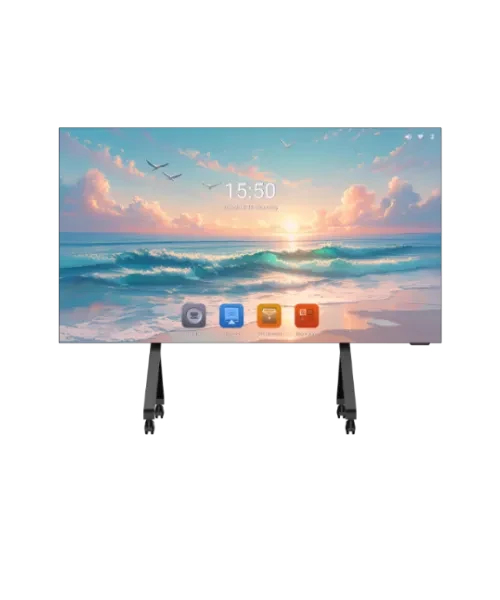


LED display technology has always been developing. In 2002, the first commercial SMD (Surface Mounted Diode) LED display technology emerged. Around 2012, COB (Chip-on-Board) technology for LED walls began shaping the display industry. Today, the latest chapter in LED display technology is the flip-chip COB LED display. Read on to understand what makes it different from face-up COB LED.
Face-Up COB vs Flip-Chip COB: What Sets Them Apart
Both face-up COB and flip-chip COB belong to the chip-on-board LED family, but their internal architecture works quite differently.
Face-Up COB mounts the LED chip with its electrodes facing upward and connects it to the PCB through wire bonding. While it does away with the individual solder points found in SMD packaging, it still relies on wire bonding, meaning it requires thin metal wires to connect each electrode on the chip to the corresponding traces on the PCB. That wire bonding step, though an improvement over SMD, still places a physical constraint on how close chips can be placed, and the wires themselves are a potential vulnerability over time.
Flip-Chip COB takes a different approach. The chip is inverted, i.e., flipped so that its electrodes face directly downward onto the PCB traces. Metal bonding then creates a direct, wire-free connection between the chip and the board. There are no gold wires across the package. The result is a more compact and structurally cleaner bond that changes what a COB LED display can achieve.
Key Advantages of Flip-Chip COB LED Technology
The shift from wire bonding to direct metal bonding is not just a manufacturing detail. It actually leads to several practical performance improvements worth noting.
1. Smaller Pixel Pitch
Wire bonding takes up physical space around each chip. Without it, chips can be placed closer together on the PCB. This is one reason why flip-chip COB LED displays can more readily achieve pixel pitches well below P1.0, a range where face-up COB and SMD designs tend to face more challenges in yield and uniformity.
2. Better Thermal Management
In flip-chip COB, the active layer of the LED sits directly against the substrate, which shortens the thermal path to the board and reduces thermal resistance. This generally leads to lower operating temperatures compared to face-up COB at equivalent brightness levels.
3. Improved Reliability
Wire bonds are a known failure point under prolonged stress from vibration, thermal cycling, or humidity. Flip-chip COB removes wire bonds from the equation. This tends to result in a lower failure rate over the product’s lifespan, though actual reliability also depends on overall build quality and usage conditions.
4. Better Color Uniformity
The tighter chip placement and more uniform light-emitting surface of flip-chip COB contribute to better color consistency and reduced color shift across the display. Without wire bond shadows interfering with light emission, the screen tends to produce a more even picture.
5. Improved Luminous Efficiency
Flip-chip design increases the effective light-emitting area on the PCB and reduces obstruction from wire bonds. In practice, this means higher brightness at the same power consumption, or similar brightness at lower power draw.
Suitable Applications for a Flip-Chip COB LED Display Solution
Flip-chip COB LED technology is particularly well-suited to environments where fine pixel pitch, visual consistency, and long-term stability are priorities.
1. Professional Displays
Control rooms, broadcast studios, and command centers typically run displays at sustained brightness, often around the clock, with operators working at close range. In these settings, pixel density, color accuracy, and low failure rates are important considerations — areas where flip-chip COB has a practical advantage over older packaging methods.
2. Premium Retail
In luxury retail environments, display quality is part of the brand experience. Uneven color or visible grain at close viewing distances can work against the overall atmosphere. The smooth surface and consistent luminance of a chip-on-board LED display make it a reasonable choice for high-end flagships and showrooms.
3. Home Cinema
Home theater installations call for good contrast, color depth, and a product that integrates cleanly into a living space. Flip-chip COB’s relatively deep blacks, wide viewing angles, and reduced moiré effect can support the kind of immersive picture quality that home cinema clients look for — though the right pixel pitch and calibration still matter greatly for the final result.
Unilumin Umini5: A Flip-Chip COB LED Display for Professional Use
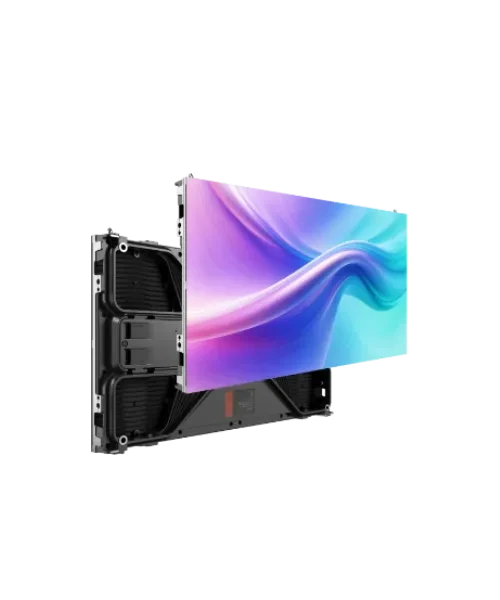
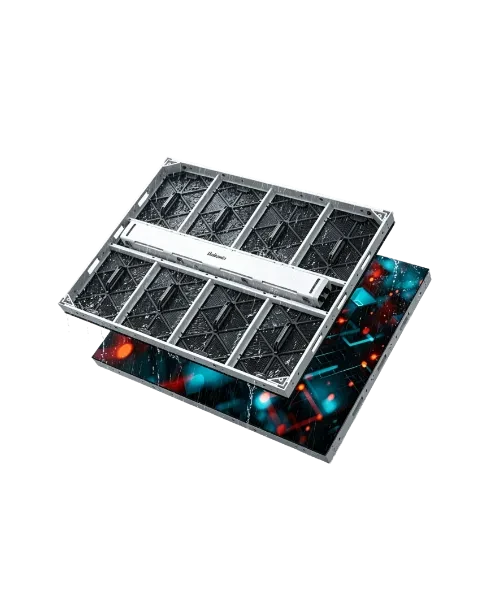
The Umini5 is Unilumin’s large-module flip-chip COB display, built around large modules, front & rear access, and energy saving as its core strengths. It spans four pixel pitches (0.93mm, 1.25mm, 1.56mm, and 1.87mm) with contrast up to 12,000:1 at 800 nits. Each cabinet uses four 150×337.5mm modules, cutting seams by 70% for a cleaner image.
EBL+ optical technology delivers deep blacks, while an anti-glare, anti-reflective, fingerprint-resistant surface suits control rooms, lobbies, and command centers. HDR support adds brighter highlights and deeper blacks.
On efficiency, GES (GaN) power supply technology and a 36℃ average screen temperature cut power use by 30% versus traditional LED, with max draw at 600 nits ranging 225–255W/m². Rear maintenance and multi-layer current protection round out the design for reliability.
The Bottom Line
By replacing wire bonding with direct metal bonding, flip-chip COB LED technology enables finer pixel pitches, improved heat dissipation, better reliability, and more consistent color output. For AV integrators, distributors, and LED specialists evaluating a COB LED display solution for demanding applications, flip-chip COB is a technology worth considering.